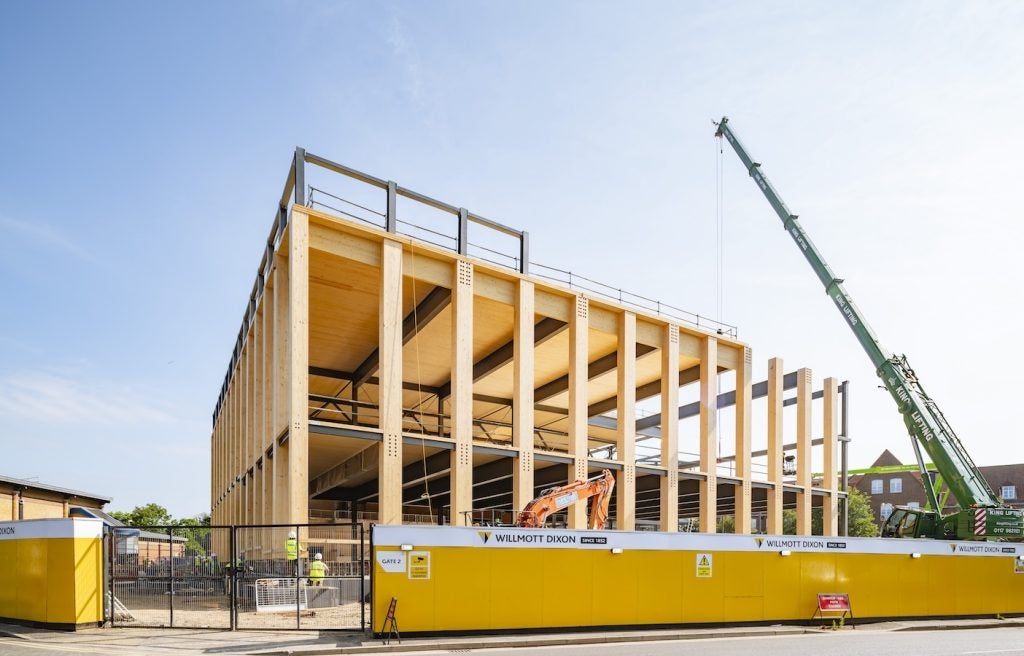

More than 2,195m³ of engineered timber has been used in a ground-breaking leisure centre project designed to Passivhaus Standards in Staines-upon-Thames.
B&K Hybrid Solutions helped deliver the UK’s largest Passivhaus leisure centre, supplying 127m³ of glulam and 2,067m³ of Stora Enso Cross Laminated Timber (CLT).
The brief for Eclipse Leisure Centre was to create the UK’s largest 50/50 wet and dry leisure centre designed to Passivhaus Standards, while meeting strict budget constraints and sustainability targets. The project needed to consume 60-70% less energy than conventional leisure facilities – a significant challenge in this sector.
The building has an eight-lane 25m main pool and 20mx10m learner pool with a movable floor, a 6-court sports hall and 950sqm of fitness space. The facility also features a flagship rooftop with four artificial football pitches, an open-plan café area, and a feature staircase, to create a welcoming biophilic entrance.
“The hybrid combination of timber and steel, as offsite manufactured products, ensured Eclipse was delivered on time and to budget, setting a new standard for hybrid leisure centres of the future,” Alex Brock at BKHS commented.
“The solution also enabled remarkable performance achievements in both airtightness and energy efficiency. The timber structure sequestered 1,668 tonnes of CO₂e, while a whole-life carbon assessment showed a 12.97% reduction in embodied carbon compared to a composite steel alternative. The building achieves airtightness of 0.4 m³/hr/m² at 50pa and targets operational energy consumption of just 120 kWh/m²/year.”
The design required innovative engineering solutions to overcome complex structural, acoustic, and moisture management challenges, particularly in high-humidity environments like the pool hall.
While timber was primarily specified for aesthetic reasons, with significant areas left exposed, this evolved into a hybrid timber-steel approach to maximise the benefits of each individual system: timber’s visual warmth, carbon sequestration properties and prefabrication benefits were expertly balanced with steel’s excellent structural performance.
BKHS worked alongside GT3 Architects, structural engineer Engenuiti, and main contractor Willmott Dixon. A cost analysis completed by Willmott Dixon also confirmed that a hybrid timber-steel solution could meet the council’s budget, without sacrificing the desired aesthetic or performance requirements.
The visual-grade timber panels eliminated the need for additional finishes, reducing both material use and long-term maintenance requirements.