

When David Venables joined AHEC in 1995, the organisation’s UK director at the time, Michael Buckley, was already supporting the Carpenters’ Awards, both financially and through a strong relationship with Awards’ founder, Terence Mallinson. In AHEC’s office – which was then based in Throgmorton Avenue, within the Carpenters’ Company grounds – David encountered an awards programme recognising the skill and artistry of UK joiners and carpenters rooted in craft and tradition. “I remember seeing some really interesting work being entered,” he recalls. “There was a huge depth of skill, representing a lot of potential in the UK wood industry. But the Awards were looking inward rather than outward.”
AHEC, meanwhile, was beginning to expand its outreach – speaking to architects, engaging with the press, and building awareness around American hardwoods. The organisation understood that architects held the key to unlocking greater possibilities for wood in contemporary design. “We realised the power of architects,” David says. “We knew if we could highlight strong case studies in wood, the press would follow. There was an opportunity to broaden the conversation.”

BECOMING A NATIONAL PLATFORM
This shift in thinking laid the groundwork for the evolution of the Wood Awards to which the Carpenters’ Awards rebranded in 2000. This signalled a shift in ambition. Around the same time, Swedish Wood (then led by Charles Trevor) was running a major timber campaign in the UK. Sensing the opportunity, David brought together Swedish Wood, the Carpenters’ Company, and Michael Buckley (then working as a timber industry consultant) to dramatically strengthen the programme.
Together, they envisioned a competition with professional project management, judge visits to shortlisted buildings, a formal ceremony, and wider industry and media engagement. “The sponsorship of AHEC, Swedish Wood and the Carpenters’ Company got the reimagined Wood Awards off the ground,” David reflects. “Together with Michael’s visionary ideas, it was a leap in ambition.”
Michael Buckley’s influence, he says, cannot be overstated. “He had a real vision. He understood the need for powerful judges and the importance of reframing the Awards: not just celebrating craft but pushing what’s possible with wood. It was about recognising projects where architects and designers really understood the material.”
This philosophical shift toward design leadership, innovation and meaningful material expression became the defining character of the modern Wood Awards.
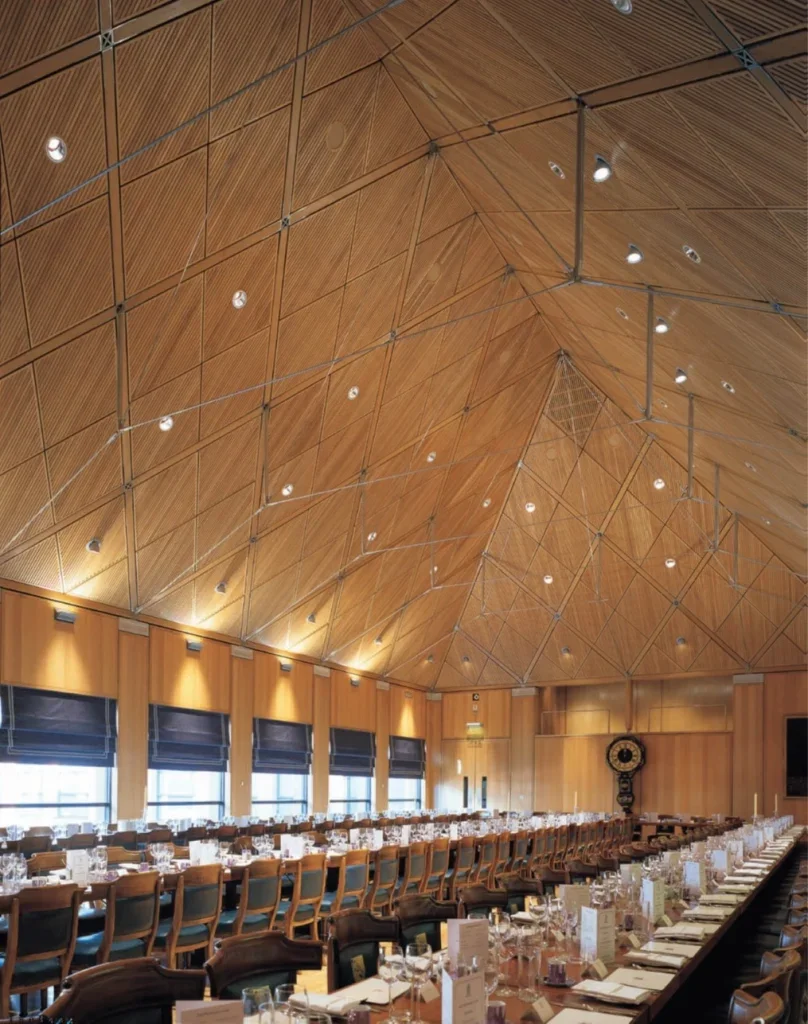
Another significant step in the early 2000s was the decision to enlist architects as judges. One of the first was Jim Greaves of Hopkins Architects, who joined after his project, the US White Oak–rich Haberdashers’ Hall, received a Highly Commended in 2003. “Bringing in Jim was transformational,” David says. “Now we had an architect who could really talk wood.”
Another long-standing judge, Andrew Lawrence, was at the time ‘the’ timber specialist at Arup – years before the firm established its own timber department. “It’s hard to look back from where we are now,” David notes, “when attitudes towards wood are so positive. Back then, only a handful of people were interested.” As more leading practitioners engaged, the Awards became an essential platform demonstrating that the UK had a robust, innovative timber industry ready to support ambitious design.
Over time, organisations such as TRADA supported administration and judging, and early financial backing also came from the Ghanaian and Malaysian Timber Councils. The Awards was evolving into a central institution of the UK timber sector, one that helped bring the industry together.
“I’m really happy that the Wood Awards sits there as a jewel in the industry’s communication crown,” David says. “It became a vehicle for recognition. And now, with the spread of social media, winners become ambassadors for timber.”
Across 25 years of continuous delivery – achieved “through collaboration and passion,” as David puts it – the Awards have also wrestled productively with the balance between craftsmanship and design innovation. “A brilliantly designed building without craft won’t be at the top of its game,” he explains. “Similarly, exquisite making without strong design doesn’t do justice to the material’s potential.”
This interplay came into focus with the Downland Gridshell, winner of the first-ever Gold Award in 2003. “It absolutely should have won the RIBA Stirling Prize,” David recalls.
The Awards increasingly became a showcase for projects using every form of timber, from CLT and plywood to beams, hardwoods and finely crafted furniture. A recent example is the Black & White Building, the 2023 Commercial and Sustainability Winner, and the first project to use thermally modified US tulipwood. “If you compare this building with what was happening at the beginning…the change is just massive,” said David.
Furniture – a crucial channel for influence
While buildings sometimes conceal their timber behind finishes and systems, furniture places wood front and centre. For AHEC, fostering this visibility has always been vital.
“Furniture is really the visible element of wood,” David says. “It’s great for communication and for media attention. And trends in wood, such as colour, character and texture, often begin in furniture and product design before migrating into architecture.”
With the Wood Awards attracting some of the UK’s most exciting furniture makers, the category has become a powerful barometer of material experimentation. The fact that the judges themselves are leading designers and makers lends great integrity and inspiration to the process. “You can’t beat being judged by respected peers,” David adds. “We’ve been so privileged with the quality of judges we’ve had.”
Notable early winners such as Sebastian Cox RDI – who won the Bespoke Award in 2011 and is now the Chair of the Furniture & Product judging panel – and Katie Walker, whose 2005 Ribbon Rocking Chair remains iconic, show how the Awards can help propel emerging designers into the spotlight.
COMMITMENT THE FUTURE
For both AHEC and the Wood Awards, supporting the next generation of architects and makers is central. AHEC’s work with emerging talent, in the UK and across Europe, aligns seamlessly with the Awards’ mission to spotlight new voices.
“I love that the Wood Awards celebrates young, unknown makers as well as huge practices,” David says. “It gives real opportunity.”
Walking into the Carpenters’ Hall on awards night encapsulates this progression. “You see the heavyweight architects and designers of today alongside the bright lights of the future,” he reflects. “It’s really exciting.”
David sees the modern Wood Awards as a true reflection of the entire UK timber industry – beyond any single organisation’s influence.
“It’s no longer ours,” he says of AHEC’s role, “but it is now housed where it always should have been – at the heart of the UK timber industry, there for everyone, large and small.”
The Awards have grown into a national institution, reshaped by collaboration, driven by a commitment to excellence, and powered by the vision shared between AHEC, the Carpenters’ Company, Timber Development UK, and the many architects, designers, makers and judges who have given their time.
The result is a cultural force that champions material intelligence, celebrates innovation, and continues to inspire the next generation of makers and architects and an ever-expanding creative use of wood across the UK.


