
A new planing plant at Rettenmeier Baltic Timber combines high performance with reliability, flexibility and precision.
Rettenmeier Baltic Timber’s new planing plant in Latvia has been designed to combine high performance with reliability, flexibility and precision.
Kallfass, a leading supplier of woodworking and sawmill technology, had to realise the high expectations of the Rettenmeier team for the project at Incukalns, Latvia.
Now completed, the high-performance system combines speed, a state-of-the-art scanner, measurement technology, as well as flexible sorting and packaging solutions.
The performance data:
- Entire system can handle 100 parts per minute,
- Planes at a feed speed of up to 500m/min
- Can produce 12 bundles per minute on the output side if necessary
Kalfass’ previous project experience with Rettenmeier and its parent company the Cordes Group meant the supplier knew what Rettenmeier wanted and helped to implement improvements from other factories.
Despite the high demands, the project only took 12 months from first contact to the start of installation, and only a further six months until the first wood package was delivered.
After the planing machine, the product spectrum ranges from small roof battens to large squared timber measuring 120 x 320mm.
“A total of 55 lorry loads were needed for the installation,” said Kallfass design engineer Helge Widmann. “Some 232 drives with a total output of 750 kW were installed.”
This was used, among other things, to design the package infeed with tilt destacking for 3m high double packages, with integrated auxiliary destacking for a quick package change, as well as an automatic disposal of the intermediate sticks and separation of squared timber.
Heavy duty a must
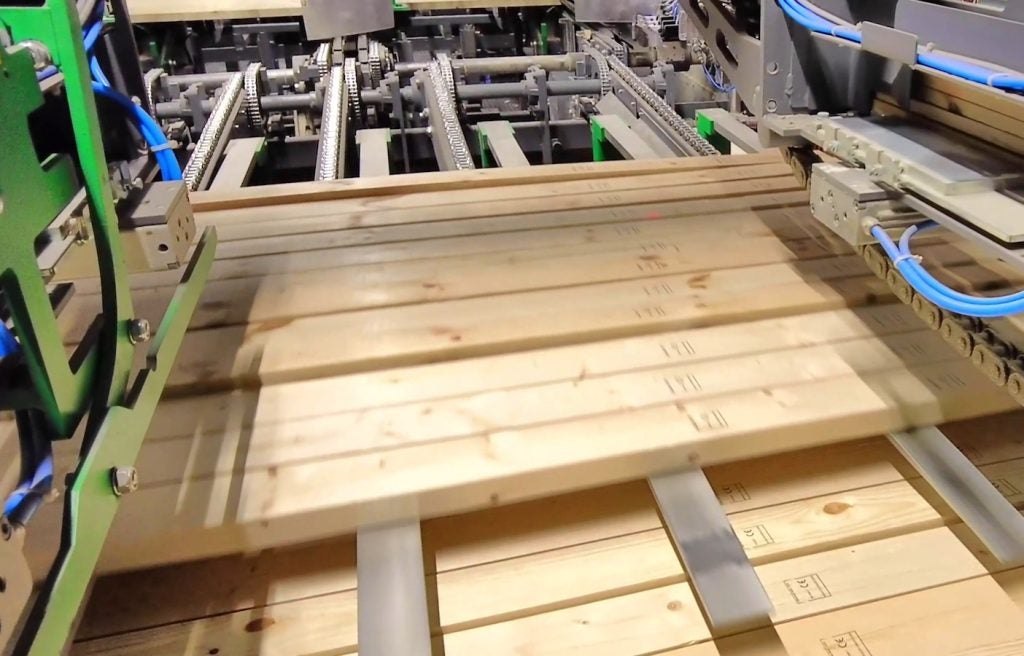
A Tongloader is used to separate the workpieces, which are up to 120mm thick and 320mm wide.
“With these dimensions, every conveyor is under extreme strain,” said Paul Schmid, Head of Technology at Rettenmeier Holding. “We received a heavy-duty system from Kallfass that has no problem with this.”
Employees can visually assess the quality, supported by a Microtec strength scanner, a Brookhuis moisture measuring unit and a cupping control. Rejects are sorted out.
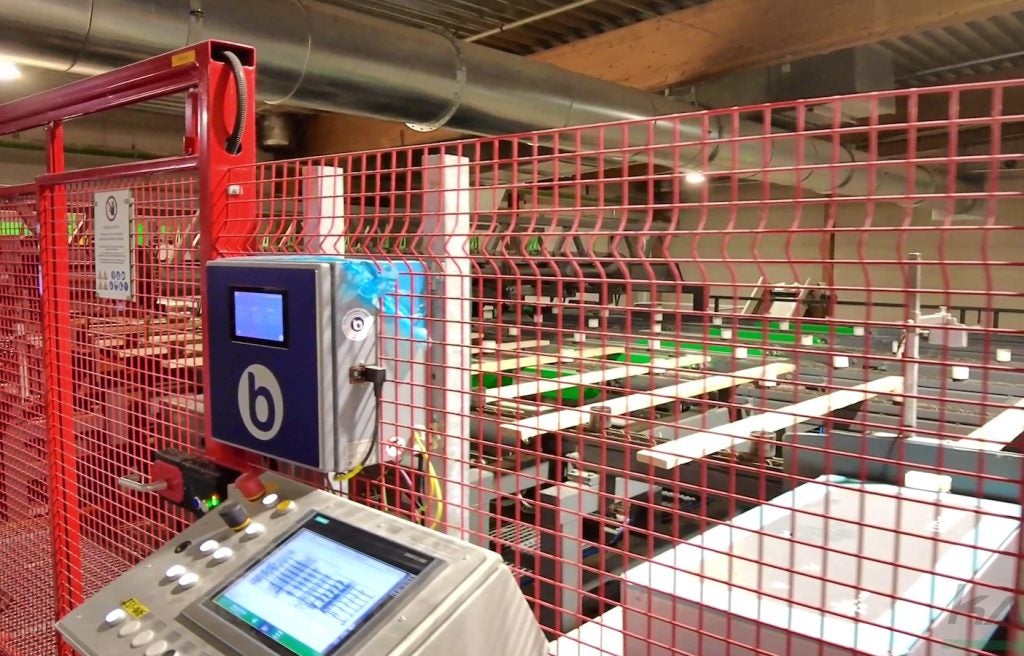
Six servo-controlled 500mm acceleration rollers transport the parts towards the Rex planning machine.
“If joint to joint planing is required, the speed increases to up to 750m/min and the gap is closed in front of the planing machine in the 8m high-speed channel,” Widmann points out.
“Why exactly 500 m/min?” asks Uwe Lutz, Sales Manager at Rettenmeier Hirschberg. “At a speed of more than 500m/min, the system is effectively just levelling out.”
In addition to classic four-sided planing, Rettenmeier can also perform profiling at 500m/min. The company produces sticks, decking and other products for the do-it-yourself industry sector.”
The end product is correspondingly diverse: After the planing machine, the spectrum ranges from small roof battens to large, squared timber measuring 120 x 320mm. Everything is designed to be processed with high precision and quality.
Immediately after the planing machine, six rollers of the Kallfass scanner infeed capture the wood. This creates defined gaps – even with chipped timber. All parts enter the Microtec Goldeneye 820 scanner in a controlled manner.
Timber product tracking included
Two slow-down belts decelerate products and transport them in transverse direction to the two stacking lines. Now, at the second operator station, split or broken planed wood can be sorted out manually.
Once again, the Tongloader cycles the goods to the downstream sorting station at high system performance. If square parts or other critical dimensions are required, a carrier chain conveyor is used instead of the Tongloader.
“Using Microtec’s ID scan, each part is assigned the corresponding result from the Goldeneye scanner,” explained Widmann. “This eliminates the need for time-consuming and risky parts tracking.”
This is followed by a labelling station with inkjet printing provided by REA. On the one hand, quality A, B and C and pieces of scrap wood are now separated at maximum speed. B-goods are placed on a parallel line, C-goods in a stanchion, while pieces of scrap wood are disposed of centrally.
The top quality goes straight into the cutting and stacking line. The parts pass through a bundling station before the Kallfass multiple cross-cut saw. Here, sticks and boards can be stacked into small bundles and strapped at a speed of 12 bundles per minute.
Central package station
A real highlight is that the qualities A and B are brought together at a central package outlet. Finally, the packages can be film wrapped and strapped. Even mini wood packages (“quarts”) can be formed. After strapping, the packages can be stacked on top of each other by a package stacker.
The production hall housing the planning line was used by the previous owner Swedwood as a warehouse. Usually, system suppliers find the width too narrow and length too short, but the hall’s 7m height was unique.
“This gave us the freedom to integrate the entire scrap wood removal system below the planing line,” explains Schmid.
Each crosscut or scrap piece is transported to the nearby silo as a chip. The system is actually built in a U-shape. The space in between is used at Rettenmeier Baltic Timber for intermediate storage directly under the roof of sticks, finished and semi-finished products.
Although the hall appears generously dimensioned at first glance, according to Schmid, “every centimetre had to be used to meet our requirements.”
EDITOR’S NOTE: This article is a version of a feature that first appeared in Holzkurier
IMAGES: Kallfass


